Intro to اِسْمٌ
Signs of an اسم
There are various ways of identifying an اسم. Let’s cover 2 main ways:
- It ends with a Tanween. e.g. رَجُلٌ, "a man"; كِتَابٌ, "a book".
- Note that the meaning is always "a something" when an اسم ends with a Tanween.
- Also note that لً لٍ لٌ are all called a Tanween (i.e. ignore the ل, that's just a random letter to show the Tanween).
- Also note that there’s a few proper nouns (ie a name) that may just have a Tanween as part of the name (sorry, there’s going to be a few confusing/complicated rules we’ll encounter, and rules with exceptions).
- It starts with ال. e.g. اَلْكِتَابُ, "the book"; اَلْرِجَاَلُ, "the man".
A noun like "the man" is called a definite noun (مَعْرِفَة) and a noun like "a man" is called an indefinite noun (نَكِرَة).
Tip
الرجال is pronounced "ar-rijaal", not "al-rijaal". Basically, all the letters in the Arabic alphabet are divided into 2 types; sun and moon letters. Sun letters, when preceded by a ل, mean the ل doesn’t get pronounced (note I may not be saying this rule 100% correctly). This doesn’t apply to moon letters. This is better explained on Wikipedia, which also shows which letters are sun and moon letters.
These 2 ways of identifying an اسم (we’ll see more later) are mutually exclusive. i.e. you’ll only ever see one of them on an اسم, not both.
Warning
There are some words that break this rule. e.g. some plural words don't have a tanween or start with ال .
Finding the root letters
When looking up an اسم in the dictionary, you’ll need to first identify it’s root letters. This isn’t an exact thing to do, but the procedure to follow is to remove letters in سالتمونيه (aside: this literally means "you asked me regarding it/her") from the اسم.
e.g. the root letters of رَجُلَيْنِ are رجل, which means "a man".
A small exercise
Here's some words for you to try and find the root letters of:
- فَاعِلٌ
- مُدَرِّسٌ
- مَسْجِدٌ
- اَلْكِتَابُ
- نَصَرَتَا
- يَضْرِبُ
Also, for these words, identify which are are اسم's and which aren't.
Some اسم's to learn
Here’s some اسم’s to learn:
| Arabic | English |
|---|---|
| اِنْسَانٌ | man |
| بَيْتٌ | house |
| تَمْرٌ | dates |
| ثَمَرٌ | fruit |
| جَاهِلٌ | ignorant |
| عَالِمٌ | learned |
| حَسَنٌ | good, beautiful |
| خُبْزٌ | bread |
| دَرْسٌ | lesson |
| ذَنْبٌ | sin |
| رَسُوْلٌ | messenger |
| زَكَاةٌ | zakah |
| سَهْلٌ | easy |
| شَيْيٌ | thing |
| صَلَاةٌ | prayer |
| ضَوْءٌ | light |
| طَيِّبٌ | good, clean |
| ظَالِمٌ | oppressor |
| عَادِلٌ | just |
| غَفُوْرٌ | one who forgives |
| فَاسِقٌ | transgressor |
| قَبِيْحٌ | ugly |
| كَرِيْمٌ | noble, generous |
| لَبَنٌ | milk |
| مَاءٌ | water |
| نَهَارٌ | day |
| وَلَدٌ | boy |
| هِرٌ | cat |
| يَوْمٌ | day |
| وَ | and |
| اَوْ | or |
Some more on اسم’s
Nouns can be specific or general, as we’ve seen. They’re also not always physical e.g. they could be an idea. And there’s some nouns that indicate a time/place, we’ll see these later.
Nouns also don’t have a tense (unlike verbs which we’ll see soon).
Here’s a list of the different types of definite nouns (note most of these you won’t know yet):
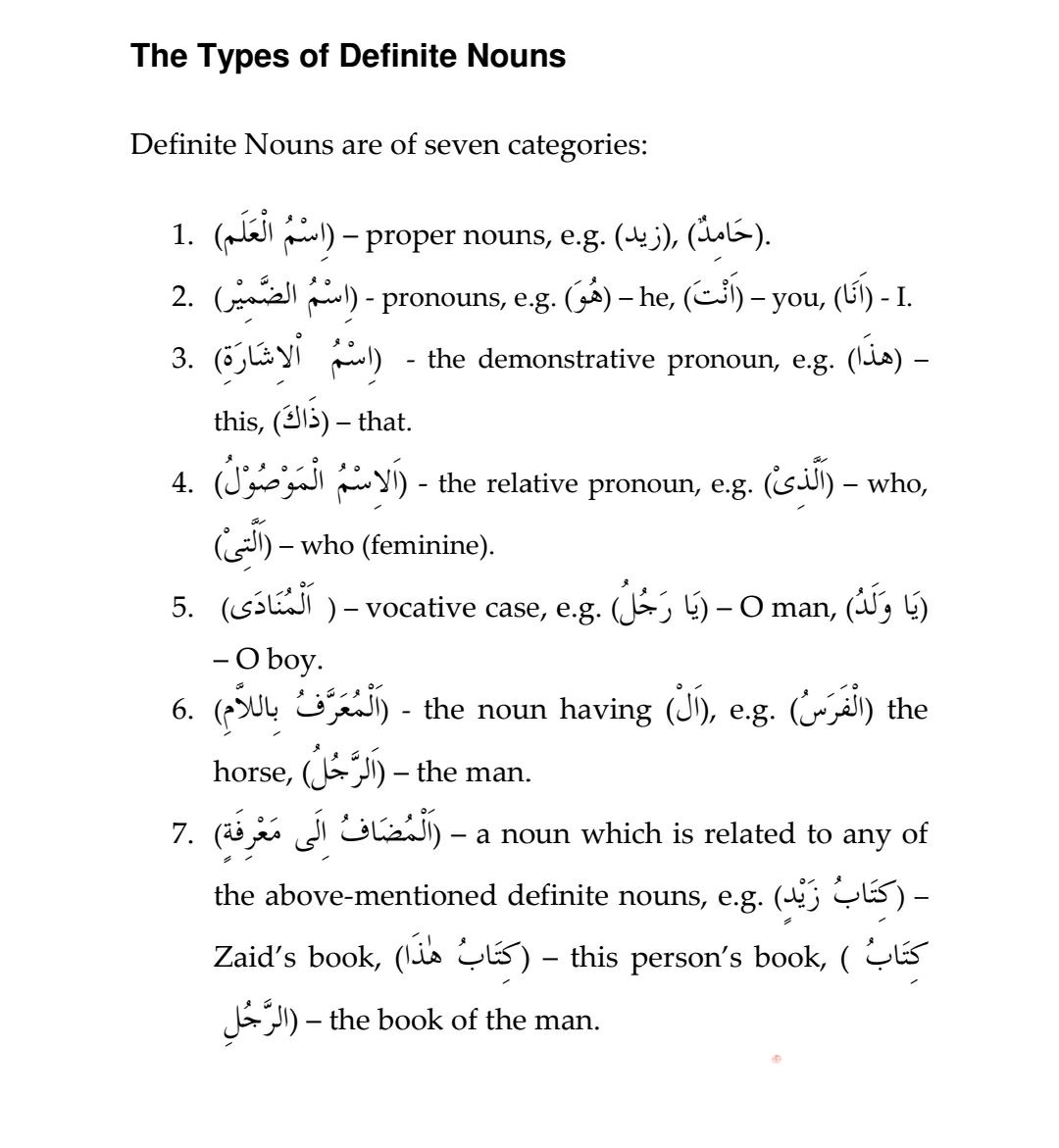
Types of definite nouns, from Arabic Tutor part 1
And here’s a list of all the signs of an اسم (again, most of these you won’t know yet):
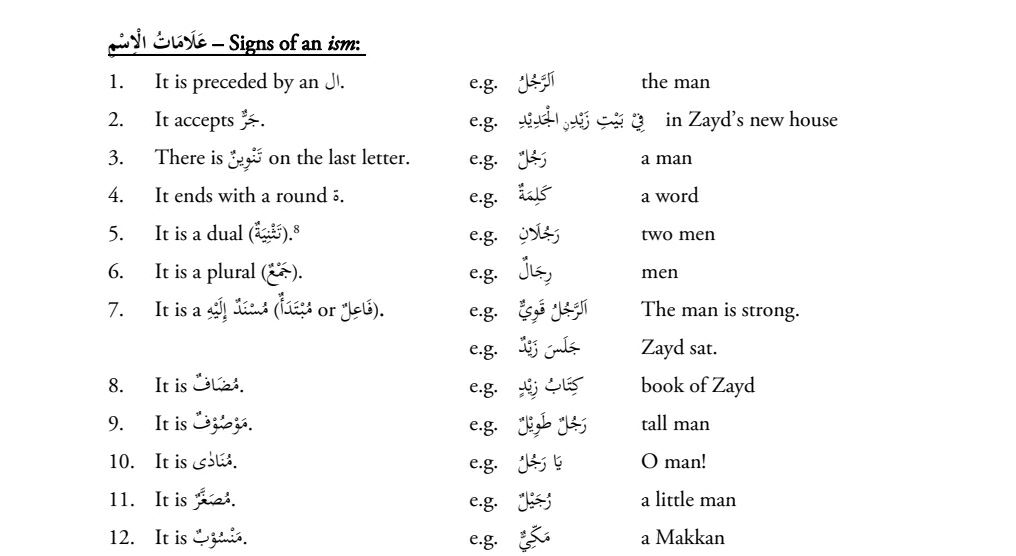
Signs of an اسم, from Tasheel Al-Nahw
Note that for number 5, to make an اسم a dual, just add a ان at the end (note this is a simplification, it's more complex than this). For number 6, plurals have to be looked up in a dictionary (we'll cover duals and plurals in more detail later).